Marvel Star Wars stats and fun pages!
|
|||||||||||||||||||||||||||||||||||||||||






































|
|
|
|
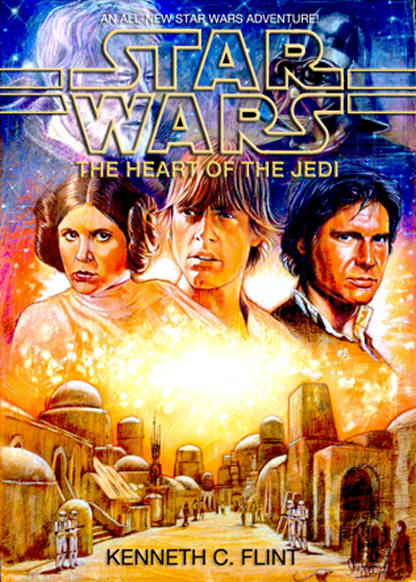
The Heart of the Jedi
Darth Vader and the Emperor are no more. The Alliance has officially become the New Republic. As Han Solo, Princess Leia and new Chief-of-State Mon Mothma emerge triumphant against the diminishing Empire, the Imperial Remnant fights on until the long-silent Imperial Senate rises up to call for peace. But not everyone wants peace, and High Admiral Tharkus has made plans to ensure the Empire will reemerge under his rule. At his side stands the mysterious Dioskouroi, beings of rare and deadly powers! For Luke Skywalker, exhausted from years of fighting, the time has come to depart upon a journey of discovery, a journey that will lead him to a secret long ago hidden by Obi-Wan Kenobi.
|
|
THE HEART OF THE JEDI E-Book (Requires e-reader) Find Ken's other books at: http://www.amazon.com/Kenneth-C.-Flint/e/B001HPFIWC See his author Facebook page at: https://www.facebook.com/pages/Kenneth-C-Flint-Author/295987127198404
|
|
Kenneth C. Flint is the published author of eighteen fantasy, horror, and suspense novels including the best-selling Sidhe series based on Celtic myth. He has also published various other fiction and nonfiction works including two Star Wars short stories and a history of 1820's Fort Atkinson. His newest novel, Ironclad, is a Civil War adventure about a Confederate terrorist attack on Washington D.C. with the world's first Weapon of Mass Destruction.
His fantasy books--a combination of legend, history, and adventure--have been reissued in E Book format by Double Dragon Publications and are available for Kindle through Amazon. New novels are also being published including sci-fi, fantasy, history, and ancient Irish myth.
In addition to his writing, Ken is a writing instructor at the University of Nebraska at Omaha and Metropolitan Community College in Omaha Nebraska. He is also a historic interpreter at reconstructed Fort Atkinson in Nebraska with his family, which includes his wife, two sons, daughter-in-law, and two grandsons.
|
|
The History of Heart of the Jedi and How it Didn't Get Published By Kenneth C. Flint
In 1991, I was making my living as an author. I was writing two books a year for Spectra, the sci-fi-fantasy imprint of Bantam Doubleday Dell. I’d had twelve books published, with a seven book backlist and a million books in print. I had just signed a new two book contract with Spectra, with titles to be decided later. Then I got an exciting word from my editor.
Because of the success of a hardcover Star Wars trilogy by Timothy Zahn, Lucasfilm had asked Spectra to publish an additional series of paperbacks. Spectra had searched through its stable for suitable authors, sending copies of our works to Lucasfilm for selection. My books were Celtic-based sword-and sorcery, but my Sidhe series books were a fantasy/sci-fi combination, and a review of Riders of the Sidhe said it “has enough derring-do for at least one Lucas film.”
Apparently George Lucas thought so too, because I was told he had personally selected me to do a Star Wars book. Even better, I would be writing Book One of the proposed series, taking place immediately after the second Death Star is destroyed [Note: This would have been followed by Margaret Weiss’ Legacy of Doom, with both books to be preceded by Jim Baikie’s Exiles of the Force four-part comic-book mini-series from Dark Horse Comics. Weiss later stated that she'd had a disagreement with Lucasfilm, and Baikie’s series was cancelled –Ed.] Being a crazy big Star Wars fan (I saw the first movie seven times in the theater and drank my coffee from a Star Wars mug), you can imagine how thrilled I was.
I was given pretty much free rein on developing my plot, other than that it should take place immediately after the second Death Star is destroyed. I up front figured it would be most logical to deal with a defeated but not destroyed Empire, its military desperately trying to regroup and retaliate against the Alliance, while other elements sought to make peace. Along with this was my assumption that I had to deal with what Luke Skywalker had become, and where he was going as a Jedi.
I spent the first months developing an outline and submitted it to my editor. I want to make the point, here, that I never, throughout all this, communicated directly with the Lucasfilm people or knew who they were. I worked for Spectra, and everything came through my editor. But I was told, and very honored to hear, that George Lucas himself had approved my plot, with one specific alteration—I had shown Sand People without their masks, and he said that that must never happen.
I spent most of the next year writing that book, putting my own books aside. My primary sources were the movies themselves, which I watched over-and-over (often in slo-mo), and a Star Wars Sourcebook for game players from West End Games that Lucasfilm supplied. By the end of 1992 I had a draft ready. I sent it in and waited… and waited. When I inquired as to how it was going, my editor said that the process of the Star Wars project had stalled as they developed the rest of the series. And she still had to go through it herself before sending it to Lucasfilm for their assessment. I believed her. Why not? I finally got a list of mostly minor stuff and started revisions.
After more months passed, I heard from my editor that “things were moving ahead again with the Star Wars project.” I finished my revisions and submitted it. Again, I was told the Lucas people approved it. In fact, they said they “quite liked it.”
Then I waited. Yet more months went by. I heard nothing. Stupidly, I had no agent through all this. I didn’t think I needed one, as I’d always dealt directly with Spectra and been fairly treated. Finally, growing concerned, I contacted an agent who contacted Spectra. He discovered only then that Spectra had determined my book couldn’t be published because it “no longer fit into the sequence for the new series.”
I was told that this happened because of my Spectra editor. She had supposedly promised another author of the group (a friend of hers, according to one source) that her book would be placed in Position One. This apparently accounted for the “delays” that I had been told about, while she wrote her own book to slip into my slot while I sat idle and ignorant of what was happening for months. I have made a point of not knowing who this other author is, and I have never been able to bring myself to read her book, or any other of the subsequent series, saddened that this so violated my love of everything Star Wars.
Did I confront Lucasfilm and try to fight this situation? Nope. I didn’t know who to contact or how, remember. I worked for Spectra. I had no resources of my own, I was pitifully naïve, and I felt pretty much powerless by that point.
Oh, they graciously let me keep the ten thousand dollar advance. And they threw me a bone letting me still do two Star Wars short stories (for Tales from Jabba’s Palace and Tales from the Mos Eisley Cantina), but I was done otherwise. None of my own books came out as the debacle went on (I would normally have published four new ones during this time). I lost my backlist of Irish books. Because of the long delay, my family pretty much lived on my advance for two years on expectation of the eventual payday from the Star Wars book.
This basically destroyed my relationship with Spectra and my career as I writer. I felt completely betrayed, and I was so depressed that I quit writing for years. Needing money to support my family with two young sons, I found a job as a Publications Consultant (meaning, tech writer) and, after another ten years, finally made up the financial loss of being all but unemployed for two years.
Finally, nearing sixty years old and with the boys both adults and employed, I decided to semi-retire and work on a book idea that had enthused me enough to try writing again… But not sci-fi or fantasy. It was to be a Civil War adventure with a Jules Vernesque plotline that had a band of Confederate agents trying to save the South by destroying Washington DC with the world’s first Weapon of Mass Destruction. It would be called NITRO!
I went back to teaching as an English department adjunct for the University of Nebraska at Omaha (my alma mater) and got the book written. I then discovered that, nowadays, an author of fiction can’t even submit a book to a publisher without going through an agent.
I searched for an agent for a couple of years, but found no one. It seems that unless they are sure they can sell a specific book of yours, they won’t handle you. I guess that seems fair. And I had been out of the business (by my own choice) a long time.
But then I got a new chance. An online publisher agreed to put out all my old novels as e-books. He also published my new book, now called Ironclad.
I’ve written other things too, since then. My family does living history at the reconstructed 1820’s frontier outpost called Fort Atkinson (near Omaha). I started a series of historical novels based at the place, and got a history book of the fort published through Arcadia.
So my old fans can still find my books through Amazon. But, man, I’d love to get Ironclad put out as a physical book, and I still have ideas for other fantasy, sci-fi, and horror plots, plus the twenty or so other Celtic/Irish books I’d still like to write. I think I’ve got at least a few viable years of authorship in me. (So, if anybody knows of somebody who’d like to represent me, I am ready to start writing two books a year again.) Otherwise, I am quite content teaching some writing classes and being the school time daycare for my two grandsons, age 3 years and 6 months.
|
|
As there have been some questions regarding the editing process for The Heart of the Jedi, I'd like to briefly clarify the process by which Ken and I approached this manuscript. As a professional editor and writer, and owner of a small-press publishing company (www.theroyalpublisherofoz.com), I've read dozens of manuscripts from both established authors and new talents, and can say with certainty that every manuscript requires some kind of editing, some of it in areas of grammar, punctuation and spelling, and other relatively minor things that if not caught can annoy or distract the reader. At times, there are more serious structural issues, narrative problems or character concerns that need to be addressed. When dealing with works that are part of a larger series (like the Oz books or Star Wars), there's an additional task that's just as important, and that is ensuring harmonious continuity across the spectrum of the series. While some readers are better at reconciling contradictions internally, for others, there are few things as aggravating as continuity errors. Contradictions great and small can take the reader out of the story by spoiling the necessary verisimilitude of the individual narrative and larger series. Hypothetically, had Lucasfilm/Del Rey opted to publish The Heart of the Jedi today, they would have edited it with continuity in mind. As the manuscript fell to me to publish, I've taken that responsibility to heart (no pun intended). I'm grateful too that author Ken Flint was enthusiastic about that process. Since the story did not have any serious structural, narrative or character issues, my goal was to keep it as close to what you would have read in 1993 as possible. By the same token, I believe, as do many of you who've contacted me, that the story deserves its place in continuity. You might think this would have amounted to a monumental endeavor, but in the final analysis, very little was altered from the original manuscript, and what small changes were made were either authored or approved by Mr. Flint. This remains his work. The majority of continuity issues had to do with its placement in time. Originally, the story would have come out a short while after the Battle of Endor. With Truce at Bakura and the post-Jedi Marvel series in that spot, it was a simple matter of shifting it over a few weeks. Also, in the section where the Imperials, Tharkos and Kantos, are discussing the shapeshifter, I've changed the dialogue slightly so that it's clear they're aware of the existence of other shapeshifters, particularly since Clawdites and Shi'ido are known in the galaxy, and it would have been odd if such high ranking Imperials had spoken as if they'd never heard of such a thing as a shapeshifter before. I also changed the name of a planet, which had originally been called Gathol, to Galvoni III. Gathol struck a little too close to Kathol (first mentioned in Star Wars: Galaxy Guide 2: Yavin and Bespin, by West End Games, but later explored in depth in the DarkStryder Campaign and its sequels), which has a very specific etymology. Galvoni III’s scant history fitted just as well with the narrative that Flint was telling. This and a few other minor name updates to match with established continuity are the most overt changes I've instituted, and I recognize that for some that might prove jarring since, for example, Clawdites weren't invented until 2002 for Attack of the Clones. But that's how the Star Wars Expanded Universe has always worked, and I don't see any reason why this story should be treated with any less consideration. Apart from a few examples like these and some very minor issues (e.g., spelling, grammar, trimmed dialogue), indicative of the editing process for any story, The Heart of the Jedi remains essentially the same as it was in 1993.I hope this helps readers to understand the process a little better. It's not every day we get to read a lost story, particularly from the early Bantam era, and at a time when there are no more Expanded Universe books or comics coming out. This book is certainly something to be thankful for, particularly to author Ken Flint for his love in sharing it with all us! Thank you, Ken!
~Joe Bongiorno |